
Graavilõhe #CranberryWeek


Welcome to Day Four of #CranberryWeek, hosted by Caroline's Cooking and A Kitchen Hoor's Adventures. We'll be sharing cranberry-inspired creations all week long in celebration of national cranberry day.


 Search #CranberryWeek to keep up to date and follow the #CranberryWeek Pinterest board for more cranberry inspiration. But first, see all the other cranberry recipes being shared today:

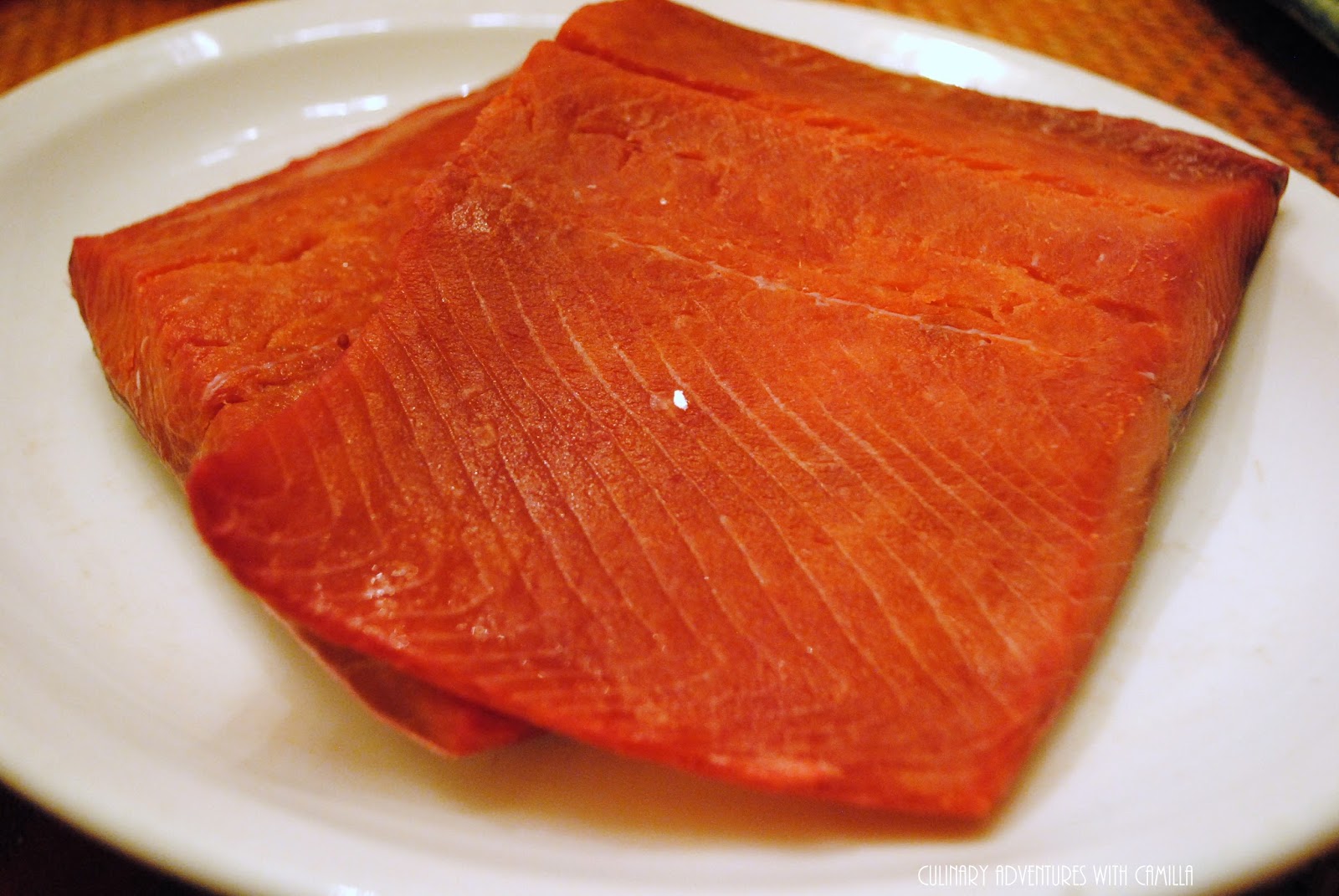
As I've been trying to offer savory cranberry recipes with an international bent, I decided to try my hand at a Scandinavian-inspired recipe: cranberry cured salmon. The recipe name I picked is the Estonian word for cured salmon; and they do have a tradition of using cranberries in their creation.

Ingredients

  • 1/2 C coarse sea salt
  • 1/2 C organic granulated sugar
  • 1 t ground black pepper
  • 3/4 C fresh cranberries
  • 3 to 4 springs fresh dill
  • 2 T red wine vinegar
  • 2 pieces of wild-caught salmon, well matched in size and shape, if possible
  • Also needed: plastic wrap

Procedure

In a blender or food processor, blend the fresh cranberries with 1 T vinegar to form a thick paste. Set aside.

Mix the salt, sugar, and pepper together. Spoon a third of the mixture on a piece of plastic wrap and place one of the salmon pieces on top of it, skin-side down. Put half of the remaining salt mixture on top of the salmon.


Spoon the cranberry mixture on top. Drizzle the filet with remaining vinegar. Sandwiching the fresh dill in between, fit the other piece of fish, skin-side up, on top. Use the remaining salt-sugar mixture on the top.


Wrap the salmon tightly with the plastic wrap. And place it in a glass container because it will weep through the duration of the curing process. Every twelve hours, flip the salmon. Do this for three days.


Before serving, rinse the salt-sugar off. 


Serve thin slices with crème fraîche and capers.

Comments

  1. I love salmon but I never tried to cure it myself. Thanks for a recipe!

    ReplyDelete

Post a Comment

Popular posts from this blog

Hot Chocolate Agasajo-Style {Spice It Up!}

photo by D For my Spice It Up! kiddos this week, I was looking for an exotic drink to serve while we learned about saffron. I found a recipe from food historian Maricel Presilla that mimicked traditional Spanish hot chocolate from the 17th century where it was served at lavish receptions called agasajos . When I teach, I don't always get to shoot photos. Thankfully, D grabbed my camera and snapped a few. Ingredients serves 14-16 1 gallon organic whole milk 3 T dried rosebuds - or 2 t rosewater 2 t saffron threads, lightly crushed 3 T ground cinnamon 3 whole tepin chiles, crushed 2 vanilla beans, split lengthwise 1 C organic granulated sugar 1 lb. bittersweet chocolate Procedure In a large soup pot that can hold a gallon plus, combine milk, dried rosebuds (or rosewater, if you are using that), saffron threads, ground cinnamon, chiles, vanilla beans, and sugar and warm over medium heat till it steams. Whisk to dissolve sugar, then lower heat an...

Ki Ngombo = Okra

In honor of Mardi Gras, I searched for traditional recipes for gumbo...only to discover that there is no canonical recipe for gumbo. It seems there are as many recipes for gumbo as there are cooks!  The only two constants in a gumbo: variety and okra. The term 'gumbo' likely comes from an African dialect whose word for okra is ki ngombo .  Gumbos can have meat, seafood, just about anything.  In Mark Huntsman's "The History of Gumbo" he refers to written mentions of using muskrat and owl in gumbo recipes.  I embraced the unlimited potential of ingredients and opted for a combination of fish, chicken, pancetta, oysters, mussels, octopus, shrimp, and squid...and lots of okra!

A Cheese Board Anchored on a Trio of Italian Cheeses + A Pinot Nero from Alto Adige #ItalianFWT on CulinaryCam.Com

I am in the process of migrating over to my new domain. Come on over to read " A Cheese Board Anchored on a Trio of Italian Cheeses + A Pinot Nero from Alto Adige " for December's #ItalianFWT.